


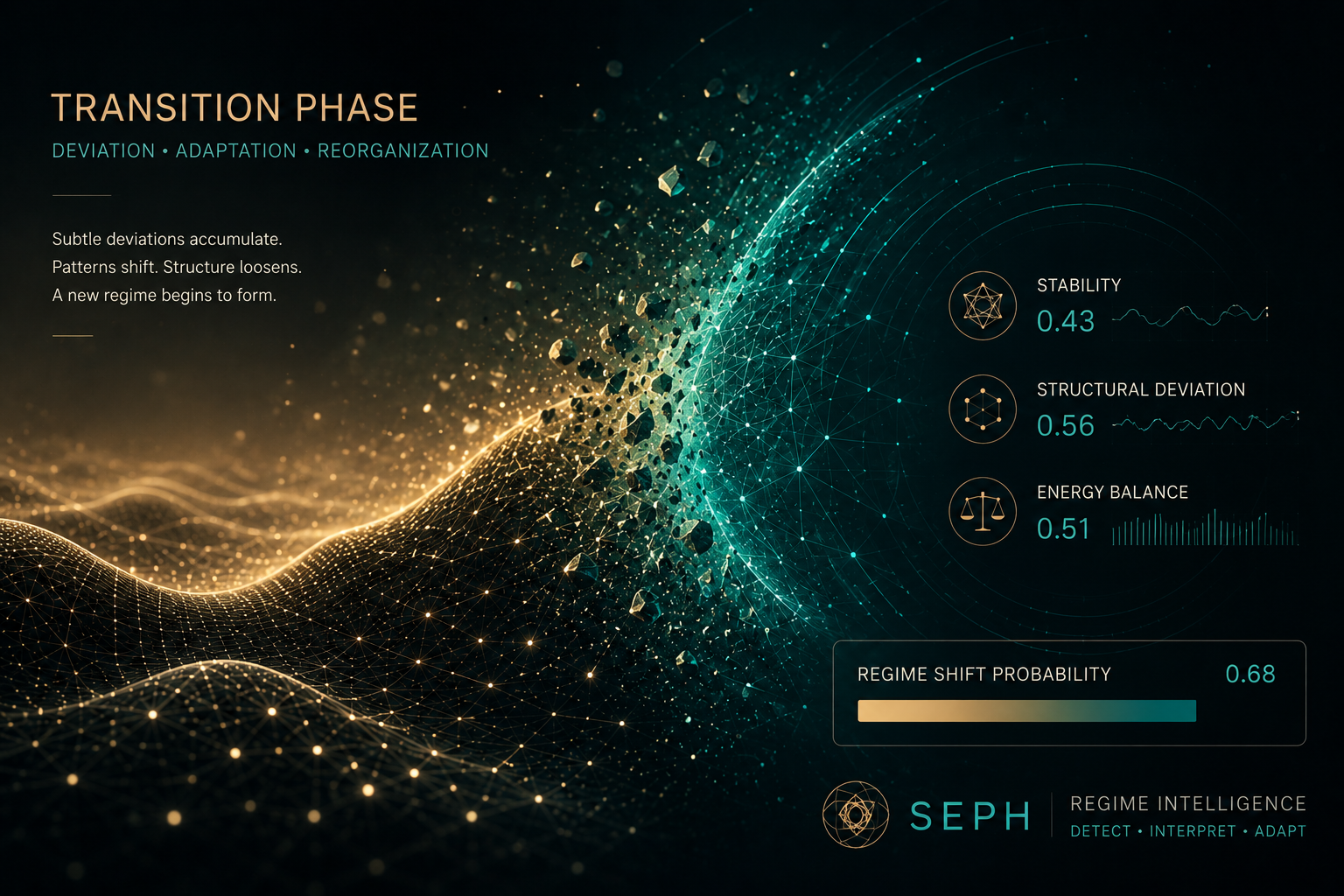
Complex systems rarely change all at once. Before a new operating regime becomes visible, subtle deviations begin to appear in structure, state, stability, energy, and relationships between system components. SEPH Regime Intelligence is designed to detect and interpret these early signals as part of the system’s evolving dynamics.
Through ShiftSense™ and the broader SEPH intelligence architecture, these deviations can be evaluated as patterns of structural change. The system can distinguish ordinary fluctuation from meaningful movement toward a new regime, creating an early computational view of transition before that transition fully develops.
The earliest sign of transformation is often not failure, but a change in the relationships that define the system.
SEPHIRA CODE
ShiftSense™ tracks structural deviation as it develops across the system. By comparing changes in state, relationships, stability, and operating conditions, it provides an early indication that the current regime is beginning to reorganize.
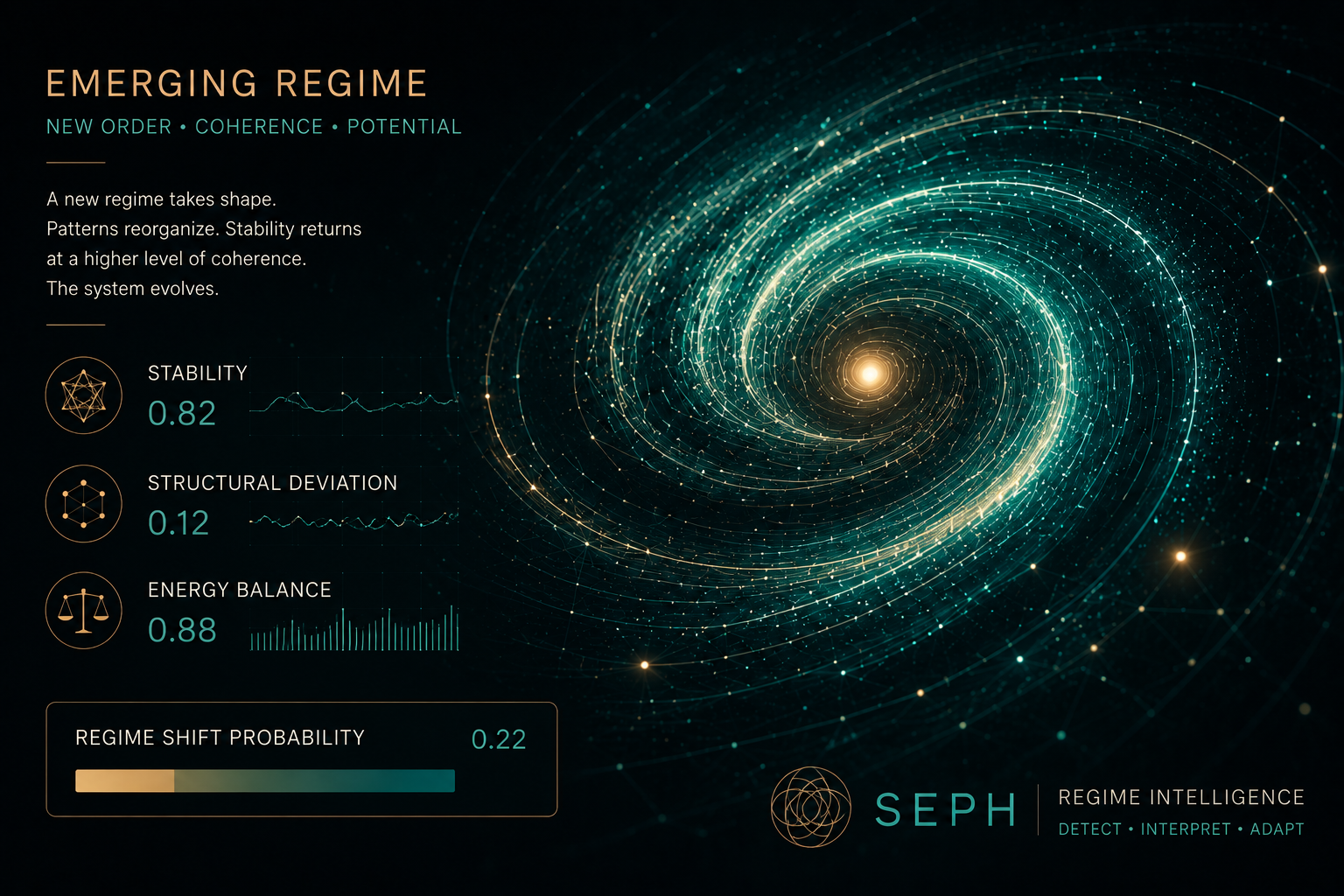
These signals can then be interpreted within the wider SEPH architecture, connecting structural change with regime recognition and adaptive response. The result is a system that can identify where change is forming, evaluate its significance, and prepare for the dynamics of the emerging regime.
FROM DETECTION TO ADAPTIVE RESPONSE
Recognizing an emerging regime is only the first step. SEPH connects detection with interpretation, allowing the system to evaluate the significance of structural change and determine how its operating strategy should evolve as new conditions emerge.
This creates a continuous intelligence cycle: detect deviation, interpret transition, identify the emerging regime, and adapt the computational response. Through this cycle, SEPH Regime Intelligence provides a mathematical foundation for systems that can remain coherent while their operating environment, internal structure, and dynamics continue to change.